22.5.12

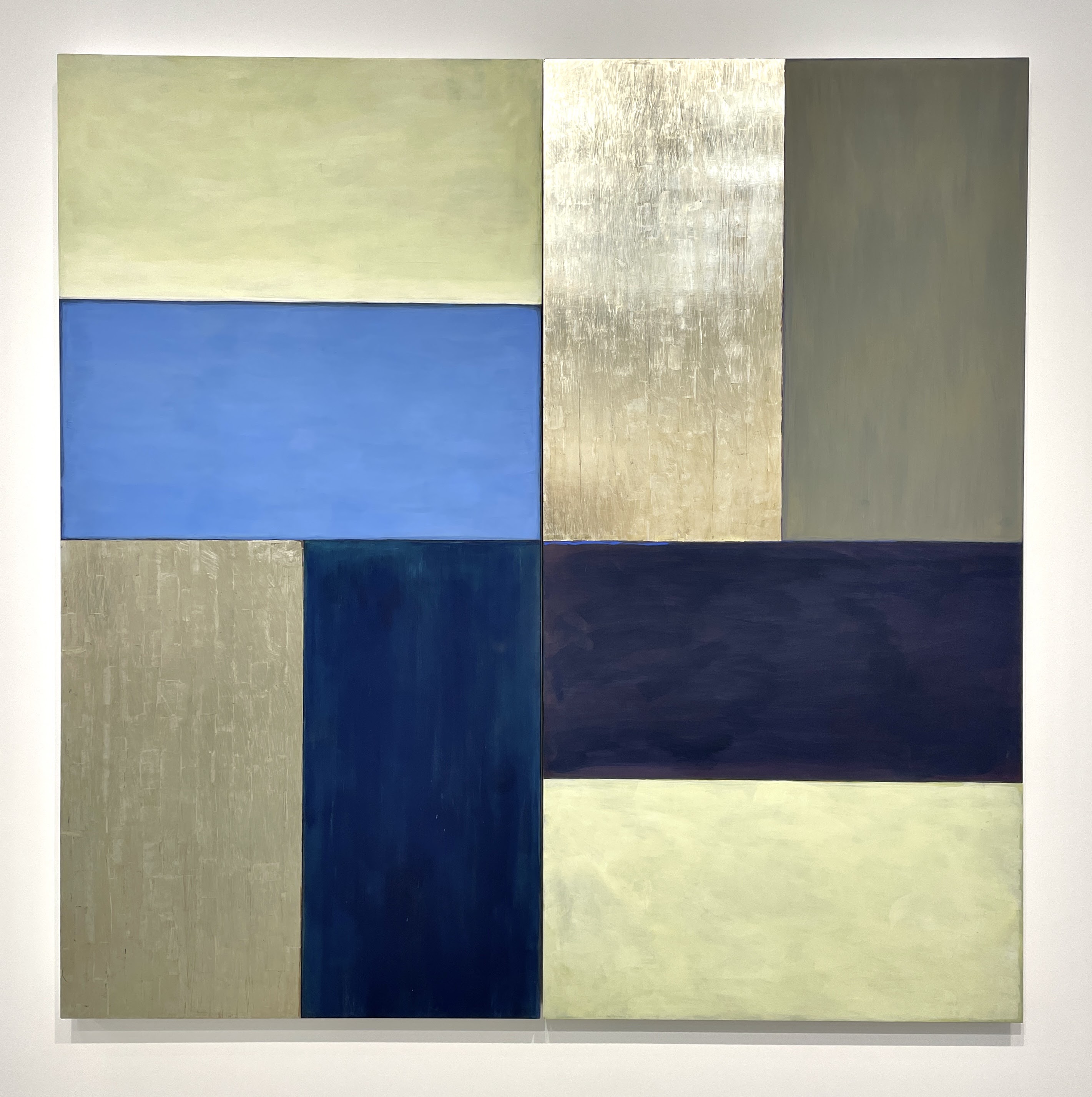
Broadway Boogie Woogie

 Piet Mondrian, Broadway Boogie Woogie, 1942-43, 50 x 50 inches, oil on canvas

It is interesting to consider Mondrian's now iconic masterpiece, Broadway Boogie Woogie, as a sort of exquisite synthesis of East and West, embodied in a revolutionary and crystalline understanding of the physicality and plasticity of the painting language. If we accept McLuhan's characterization of Western thought as sequential and rational, and of the Eastern conception of reality as a "total inclusive field of resonance", we can watch Mondrian develop the mechanics of his language as a lifelong sequential process -- slowly and deliberately shaping his idiom in search of an ultimate integration. This process seemed to accelerate in the last few years of his life. In the painting Trafalgar Square and several other works from the late thirties, we see the prediction of Mondrian's final radical shift. He begins to employ small colored rectangles that are not bound by black, and that are placed in rhythmic intervals along a linear path. This is important because for the first time the artist is introducing an element that seems to acknowledge and mimic the kinetic opticality of the little white lights that appear and disappear in the viewer's retina at each point where the black lines cross -- an effect that magically transforms the concrete object into an ineffable experience. I think Mondrian's keen awareness of this effect led him to find a way to employ its rhythmic complexity to achieve his goal -- a total inclusive field of resonance.  

 Piet Mondrian, Trafalgar Square, 1939-43, 57 x 47 inches, oil on canvas (image from MoMA website)

Of course Mondrian's "image" is inseparable from the physical quality of his surfaces, where each shape has both a discrete presence and an irreducible role in the total configuration.

 Broadway Boogie Woogie (detail)

 Broadway Boogie Woogie (detail)

 Broadway Boogie Woogie (detail)

 Broadway Boogie Woogie (detail)

Piet Mondrian, Broadway Boogie Woogie with frame at MoMA

6.5.12

Artist Documentation Program


Jasper Johns and Carol Mancusi-Ungaro 

For painters, materials and processes are essential aspects of the total conception the work. Most artists quite like talking shop, and a discussion of materials can be a catalyst for reflection about attitudes and ideas that are at the core of an artist's thinking. That understanding is what makes the Artist Documentation Program so fascinating and so important. Initiated in 1990 by Carol Mancusi-Ungaro, the brilliant conservator who was responsible for salvaging the badly damaged Rothko Chapel paintings, the ADP is an ongoing series of videotaped interviews with prominent artists including Ann Hamilton, Jasper Johns, Brice Marden, Max Neuhaus, David Novros, Rudolf Stingel, Sarah Sze, Cy Twombly, and many more. Each session is more than an hour in duration, and begins with simple questions about the materials used in specific works, then ultimately expands into astonishingly candid and detailed discussions of the artist's intent.  

David Novros, Untitled, 1976, 120 x 360 inches, oil on canvas

Ms. Mancusi-Ungaro is remarkably adept at asking questions that lead to revealing insights into each artist's thinking process as well as rarely glimpsed details about how certain works were made. For painters, as for conservators, this series is an almost endless well of technical and conceptual information. 


Brice Marden and Carol Mancusi-Ungaro

30.3.12

KAZIMIRA RACHFAL at Janet Kurnatowski

Kazimira Rachfal, ananta, 2012, 16 x 16 inches, oil on canvas

In her third solo exhibition at Janet Kurnatowski Gallery (through April 22), Kazimira Rachfal presents a group of spare and deeply evocative paintings. The ten new works in the show are all very small scale and are installed with plenty of space around them, heightening the compressed presence and intimacy of each piece. Employing an iconic motif -- a rectangle with a slightly curved angular top, contained in varying ratios by a solid field and the edges of the canvas -- the artist explores the nuances of proportion, touch and color. The surfaces vary from impasto to thin veils of oil, arrived at through a long slow intuitive layering process that leaves traces of each previous action. These paintings are both intensely sensual and eloquently understated. There is a quietness to this work, a sort of splendid stillness that conjures ancient connections to ontological mysteries -- each work an embodiment of a series of essential transformative encounters.

Kazimira Rachfal, the lightness of being, 2011, 10 x 10 inches, oil on canvas

Kazimira Rachfal, over the misty breakers, 2011, 24 x 18 inches, oil on canvas


Kazimira Rachfal, as under a green sea, 2011, 10 x 8 inches, oil on canvas

Kazimira Rachfal, the myth of approach, 2011, 17 x 13.25 inches, oil on canvas

Kazimira Rachfal, the lovely goddess launched him, 2011, 5 x 7 inches, oil on canvas

Kazimira Rachfal, climbing the bronze sky, 2011, 26 x 28.25 inches, oil on canvas

Kazimira Rachfal, this night at last, 2010, 8 x 6 inches, oil on canvas

Kazimira Rachfal, the symmetries of translation in space, 2011, 20 x 12 inches, oil on canvas

27.3.12

GONÇALO IVO at Galerie Boulakia, Paris

CONGRATULATIONS and very best wishes to Gonçalo Ivo on the opening of his exhibition of new paintings at Galerie Boulakia in Paris, March 31. The show runs through May 15 -- what better way to welcome springtime in Paris.

1.3.12

GENE DAVIS: 1958-1960

Gene Davis, Black Red Orange, 1958, 12 x 10 inches, oil on canvas

It is always interesting to me to observe the moment when an artist opens a new door to his or her vocabulary or process -- the first glimpse of what will become a lifelong trajectory. Gene Davis, probably the most under-appreciated of the Washington DC color painters, began in 1958 to make very small paintings that employed vertical stripes and explored elemental rhythms and color resonances. The purity and potency of these first canvases is extraordinary, and their direct simplicity gives way by 1961 to the highly complex arrays and huge scale for which Davis is best known. But it is sometimes important to revisit and appreciate the clarity of the original impulse.

Gene Davis, Untitled, 1958, 10 x 12 inches, oil on canvas

Gene Davis, Salute, 1958, 14 x 20 inches, oil on canvas

Gene Davis, Two Yellows, 1959, 10 x 12 inches, oil on canvas

Gene Davis, Red Rattle, 1959, 34 x 34 inches, oil & magna on canvas

Gene Davis, Untitled, 1959, 34 x 43 inches, acrylic on canvas

Gene Davis, Pink Stripe, 1960, 92 x 62 inches, magna on canvas

Gene Davis , Untitled, 1960, 91 x 91 inches, acrylic on canvas

Gene Davis, Sun Ball, 1960, 88 x 93 inches, magna on canvas

Images from Artnet.com

LUCIANO FIGUEIREDO

Congratulations to Brazilian artist & writer Luciano Figueiredo on his recent exhibition of new paintings at Galerie des Docks in Nice.

Luciano Figueiredo, Triptyque Rose1 Bleu Rose2, 2012, each panel 80 x 80 cm, acrylic on balsa wood

24.2.12

GONÇALO IVO: New Monograph

Gonçalo Ivo: Oratório
Essays in English, French & Portuguese by
Steven Alexander, Edgar Lyra, Luiz Eduardo Meira de Vasconcellos, Marcelin Pleynet
Published by
Contra Cappa Livraria LTDA, Rio de Janeiro, Brazil
February 2012
260 pages, hard cover, profusely illustrated
ISBN: 978-85-7740-099-7


I am extremely pleased and honored to be a contributor to this magnificent new book on the work of Brazilian painter Gonçalo Ivo. It focuses primarily on work from the past three years, an incredibly prolific and important period in the development of this artist's deep body of work. The book itself is exquisite -- gorgeous reproductions, beautiful paper -- and features many new paintings that have never been shown, along with monumental scale paintings from his 2010 exhibition at Galeria Anita Schwartz in Rio. You can read my essay HERE.


Gonçalo Ivo, Oratorio da Noite, 2010, 260 x 660 cm, oil on linen


Gonçalo Ivo, Santa Maria de Taull, 2009, 260 x 650 cm, oil on linen


Gonçalo Ivo in his studio, Teresopolis, Rio de Janeiro, 2010

5.2.12

TERRY WINTERS at Matthew Marks

Terry Winters, Tessellation Figures, 2011, 88 x 112 inches, oil on linen

There has been a run of luscious painting in Chelsea this season, and right up there is a group of new works by Terry Winters at Matthew Marks Gallery, through April 14, 2012. The show, titled Cricket Music, Tessellation Figures, & Notebook, features 14 large recent paintings, and in a smaller space down the street, a group of fascinating collages that illuminate Winters' working and thinking process. Using tessellations and knot theory as a starting point, Winters builds complex organic systems of shapes and colors that accumulate in layers of floating, overlapping and interconnecting planes -- all emerging from a soupy painting space. At a distance, the complex patterns undulate and vibrate with carefully calibrated color resonances. As we move up close, the rich surfaces reveal an intuitive process of constant revision -- sensual physical presences.

Terry Winters, Cricket Music, 2010, 88 x 112 inches, oil on linen

Terry Winters, Tessellation Figures (6), 2011, 80 x 76 inches, oil on linen

Terry Winters, Tessellation Figures (12), 2011, 80 x 76 inches, oil on lines

Terry Winters, Tessellation Figures (4), 2011, 80 x 76 inches, oil on linen

Terry Winters, Tessellation Figures (4), Detail

6.1.12

Studio Visit with ERIC HOLZMAN

Eric Holzman, 2012, oil on canvas, about 50 x 36 inches

It was a privilege and a treat to spend some time with Eric Holzman in his Soho studio last week -- looking at a group of new paintings, some works in progress, and some older paintings being reworked. In fact Eric often works for years on a painting, constantly shifting shapes and adjusting color -- leaving it, coming back months later and opening it up again. Recently he has been attempting to shorten that process a bit with a series of paintings that utilize and explore the kind of abbreviation he achieves in his drawings.

Eric Holzman, 2012, work in progress, oil on canvas (above), and a group of small paintings, oil on linen (below)


Eric Holzman, 2012, oil on canvas, about 32 x 36 inches

Eric Holzman, 2012, oil on canvas, about 30 x 40 inches, w/ detail below


Eric Holzman, 2011-2012, drawings, above and below


Eric Holzman, 2012, oil on canvas, about 30 x 40 inches, w/ detail below

Read my post about Eric's exhibition last year at Sideshow HERE.